CycleVLA: Proactive Self-Correcting Vision-Language-Action Models via Subtask Backtracking and Minimum Bayes Risk Decoding

Preprint


1 Department of Computer Science, University of Oxford
2 Oxford Robotics Institute, University of Oxford
3 Department of Engineering, University of Cambridge
Corresponding author

arXiv Code
CycleVLA

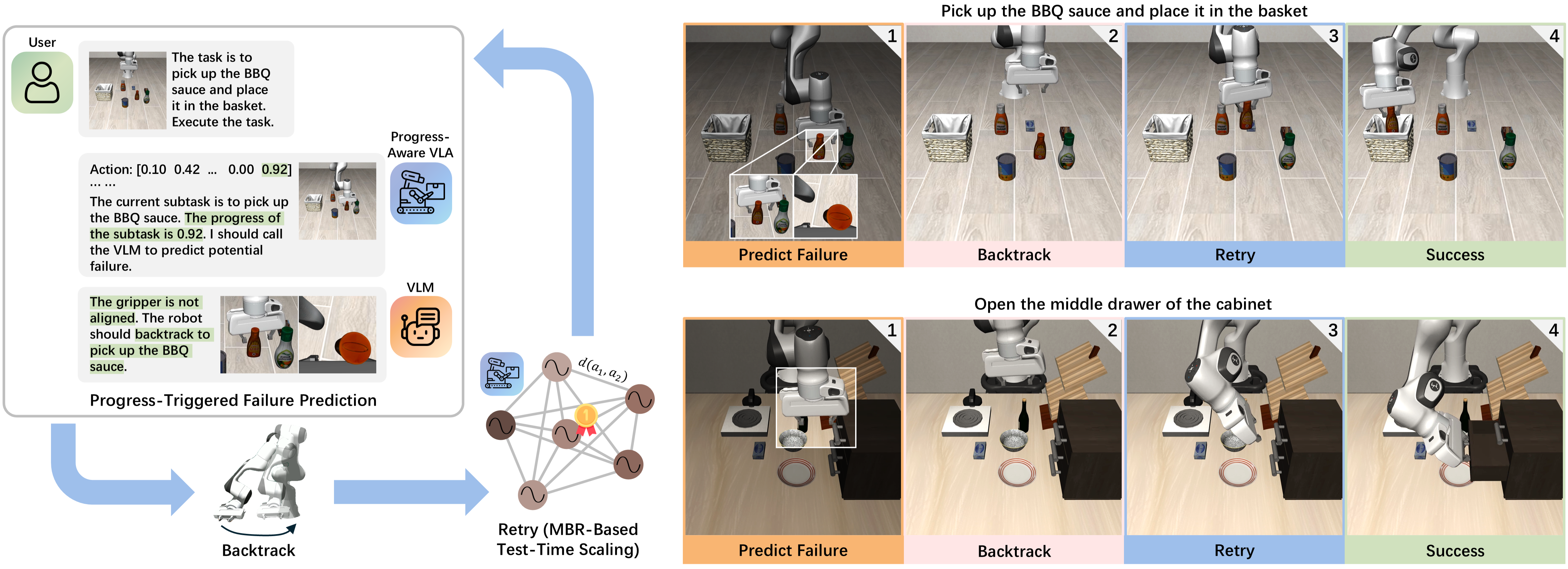
TL;DR: We introduce CycleVLA, a system that enables VLAs to anticipate incipient failures, backtrack, and recover before execution collapses. CycleVLA corrects both natural failures arising from the robot's own execution and human-injected errors such as displaced or swapped objects.

Video

Abstract

Current work on robot failure detection and correction typically operates in a post hoc manner, analyzing errors and applying corrections only after failures occur. This work introduces CycleVLA, a system that equips Vision-Language-Action models (VLAs) with proactive self-correction, the capability to anticipate incipient failures and recover before they fully manifest during execution. CycleVLA achieves this by integrating a progress-aware VLA that flags critical subtask transition points where failures most frequently occur, a VLM-based failure predictor and planner that triggers subtask backtracking upon predicted failure, and a test-time scaling strategy based on Minimum Bayes Risk (MBR) decoding to improve retry success after backtracking. Extensive experiments on the LIBERO and LIBERO-Plus simulation benchmarks show that CycleVLA surpasses the state-of-the-art VLA π0.5, improves success rates by correcting execution failures across VLAs of varying capability, from under-trained ones to fully converged policies, and that MBR serves as an effective zero-shot test-time scaling strategy for VLAs. On a real robot, CycleVLA reaches a 91% average success rate on one precise and two long-horizon manipulation tasks. We further conduct stress tests with multiple manually injected perturbations (e.g., swapping in a distractor at the expected location while relocating the true target object mid-execution), where CycleVLA corrects ~80% of injected failures and maintains success rates comparable to unperturbed execution.

Method Overview

Method Overview

Motivation: Current work on robot failure detection and correction typically operate in a post hoc manner, analyzing errors and applying corrections only after failures occur. Our goal is to equip VLAs with proactive self-correction, the capability to anticipate incipient failures and recover before they fully manifest during execution.

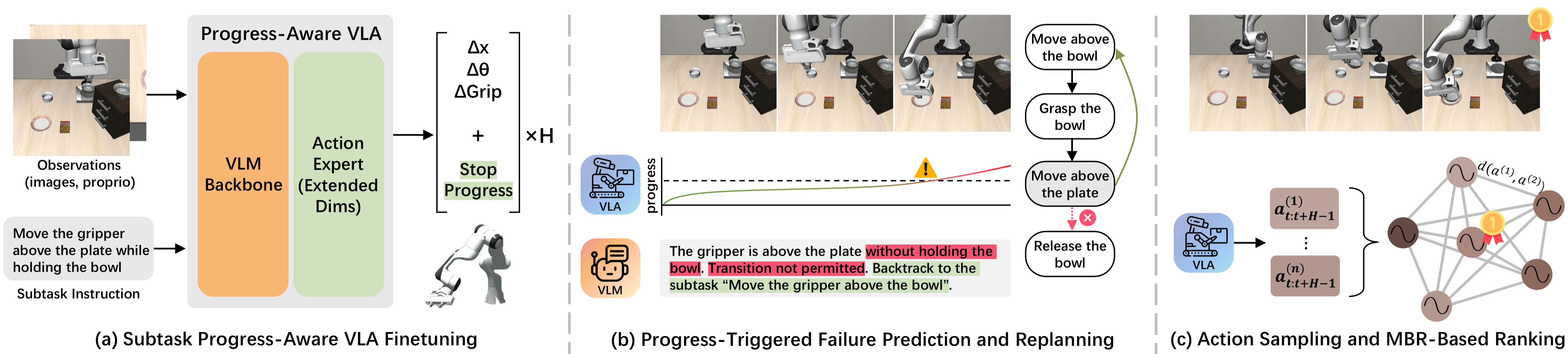
Key Insight: Many robot task failures occur at subtask transitions, and that progress near subtask completion provides strong cues for anticipating such failures (e.g., one can tell a peg is misaligned before it jams during insertion).

Approach: CycleVLA first introduces (a) a finetuning pipeline that equips a VLA with subtask-level stop and progress prediction via extended action expert dimension and augmented subtask-decomposed training data. (b) At inference, predicted progress triggers a VLM-based failure predictor and planner, which decides whether to transit to the next subtask or backtrack, and selects the subtask to backtrack to. (c) After backtracking, the VLA retries execution using test-time scaling via MBR decoding to improve success. (d) This cycle repeats until the task succeeds or execution terminates.

Qualitative Results

Simulation Rollouts

We showcase how CycleVLA corrects failures arising from the policy's own execution in simulation.

Failure: Misgrasp

Put BBQ sauce in basket
🔄 → ✅

Failure: Wrong task

Open the stove
🔄 → ✅

Failure: Wrong object

Put soup and sauce in basket
🔄 → ✅

Failure: Misgrasp

Put milk in basket
🔄 → ✅

Failure: Wrong bowl

Place bowl on cabinet onto plate
🔄 → ✅

Failure: Wrong task

Open the middle drawer
🔄 → ✅

Real-Robot Rollouts: Natural Failure

We showcase how CycleVLA corrects failures arising from the policy's own execution on an AgileX PiPER arm. Speed 3×

Teapot hanging
❌ Misgrasp
🔄 → ✅

Fruit sorting
❌ Premature movement
🔄 → ✅

Cookware packing
❌ Premature movement
🔄 → ✅

Real-Robot Rollouts: Human-Injected Errors

We stress-test CycleVLA by manually injecting three progressively more challenging error types: Distractor Introduction, Target Displacement, and Target Substitution. Speed 3×

Target Displacement: We perturb the position and orientation of the placement target during interaction.

❌ Perturb mug holder location
🔄 → ✅

❌ Perturb grape and plate locations
🔄 → ✅

❌ Perturb corn can and milk locations
🔄 → ✅

Target Substitution: We replace the target object with an unrelated one and move the original target elsewhere.

❌ Substitute with pink teapot
🔄 → ✅

❌ Substitute with eggplant and sausage
🔄 → ✅

❌ Substitute with pepper and mayonnaise
🔄 → ✅

Distractor Introduction: The target object remains unchanged, but we place a visually similar distractor nearby.

❌ Distract with pink teapot and pink cup
🔄 → ✅

❌ Distract with eggplant and sausage
🔄 → ✅

❌ Distract with pepper and mayonnaise
🔄 → ✅

BibTeX

@article{ma2026cyclevla,
  title={CycleVLA: Proactive Self-Correcting Vision-Language-Action Models via Subtask Backtracking and Minimum Bayes Risk Decoding},
  author={Ma, Chenyang and Lu, Kai and Yang, Guangyu and Liu, Jiuming and Xu, Shitong and Byrne, Bill and Havoutis, Ioannis and Trigoni, Niki and Markham, Andrew},
  journal={arXiv preprint arXiv:2601.02295},
  year={2026}
}